

Authenticating#
Connect with a profile: your API key, base URL and workspace, stored in the config file that Nominal’s other clients also read.
If Nominal’s Python client or CLI already works on this machine, you have a profile already, so skip to Connecting. Otherwise, set one up.
There is a one-time setup of API-keys required to use Nominal clients. There are 2 steps:
1. Copy your keys#
Visit your API keys page in the cloud Nominal app, and copy three values.
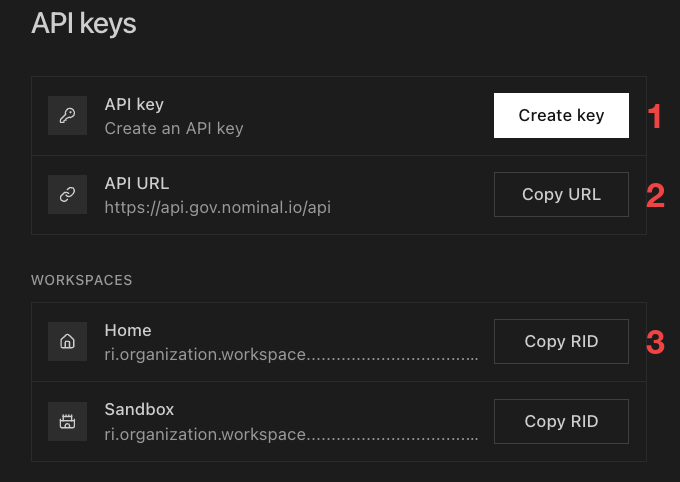
There are 3 values:
API key: Click CREATE KEY, give the key a name, set an expiration, and click GENERATE KEY. Note, this is only shown once.
Base URL: Find API URL and click COPY URL.
Workspace RID: Find your workspace and click COPY RID.
2. Store them with a command line tool#
Nominal provides two command line tools, a Rust-based one, nomctl, and a Python-based one. Use nomctl unless you already use the Python client or IT restrictions make the Python CLI easier to install.
Rust: nomctl
To install, run:
In PowerShell:
irm https://raw.githubusercontent.com/nominal-io/nominal-client-rs/main/scripts/install.ps1 | iex
The installer also adds nomctl to your PATH.
curl -fsSL https://raw.githubusercontent.com/nominal-io/nominal-client-rs/main/scripts/install.sh | sh
If you get an error that nomctl is not found when running the steps below, either call ~/.local/bin/nomctl directly or add ~/.local/bin to your PATH and open a new terminal:
echo 'export PATH="$HOME/.local/bin:$PATH"' >> ~/.bashrc
curl -fsSL https://raw.githubusercontent.com/nominal-io/nominal-client-rs/main/scripts/install.sh | sh
If you get an error that nomctl is not found when running the steps below, either call ~/.local/bin/nomctl directly or add ~/.local/bin to your PATH and open a new terminal:
echo 'export PATH="$HOME/.local/bin:$PATH"' >> ~/.zshrc
Finally, to create the credential file using the three credentials collected above, run:
nomctl config profile add default -t <1:api-key> -u <2:base-url> -w <3:workspace-rid>
To check the profile was saved:
nomctl config profile list
Tip
nomctl config init creates the profile interactively instead, and lets you pick your workspace from a list rather than pasting its RID.
Python: nominal.cli
To install, run pip install nominal. If your system Python blocks pip install, as on some Linux distributions and with Homebrew’s Python on macOS, install into a virtual environment, or use uv tool install nominal or pipx install nominal and run nom in place of python -m nominal.cli below.
Then, using the three credentials collected above, run the first command below. The second checks the profile was saved.
python -m nominal.cli config profile add default -t <1:api-key> -u <2:base-url> -w <3:workspace-rid>
python -m nominal.cli config profile list
python3 -m nominal.cli config profile add default -t <1:api-key> -u <2:base-url> -w <3:workspace-rid>
python3 -m nominal.cli config profile list
python3 -m nominal.cli config profile add default -t <1:api-key> -u <2:base-url> -w <3:workspace-rid>
python3 -m nominal.cli config profile list
The credential file holds your API key in plain text, so keep it out of version control and shared folders!
Details#
Create the config file by hand
Instead of using a command line tool, you can save the file yourself, with the three values from step 1:
Save it as %USERPROFILE%\.config\nominal\config.yml:
version: 2
profiles:
  default:
    token: API_KEY
    base_url: BASE_URL
    workspace_rid: WORKSPACE_RID
Save it as ~/.config/nominal/config.yml:
version: 2
profiles:
  default:
    token: API_KEY
    base_url: BASE_URL
    workspace_rid: WORKSPACE_RID
Save it as ~/.config/nominal/config.yml:
version: 2
profiles:
  default:
    token: API_KEY
    base_url: BASE_URL
    workspace_rid: WORKSPACE_RID
Profiles
Each key under profiles (default in the template above) is a profile name, and you can add more profiles to connect to other workspaces or instances.
Create one profile for each workspace, each with its own name. Profiles in the same organization can usually share an API key.
Connecting#
c = nominal.Client.fromProfile();            % the profile called "default"
c = nominal.Client.fromProfile("staging");   % any other profile
With an API key in code#
A key written into a script ends up in version control, so use a profile where you can. Without a profile, pass all three values:
c = nominal.Client.fromToken("<api-key>", BaseUrl="<base-url>", Workspace="<workspace-rid>");
In CI#
connect reads the profile when there is one, and otherwise the API key in the
NOMINAL_TOKEN environment variable:
c = nominal.Client.connect();
NOMINAL_TOKEN holds only the key, so without a profile the client reaches Nominal production
with no workspace. connect raises a nominal:profileFallback warning when it falls back.
Migrating from the old config file
If this machine still has ~/.nominal.yml with an environments: block, fromProfile
detects it and tells you to run:
nom config migrate
Checking the connection#
whoAmI makes a request to Nominal, so a bad key fails here instead of at the first real call.
c.whoAmI()