SigMF stream#
Replay a radio recording in real time
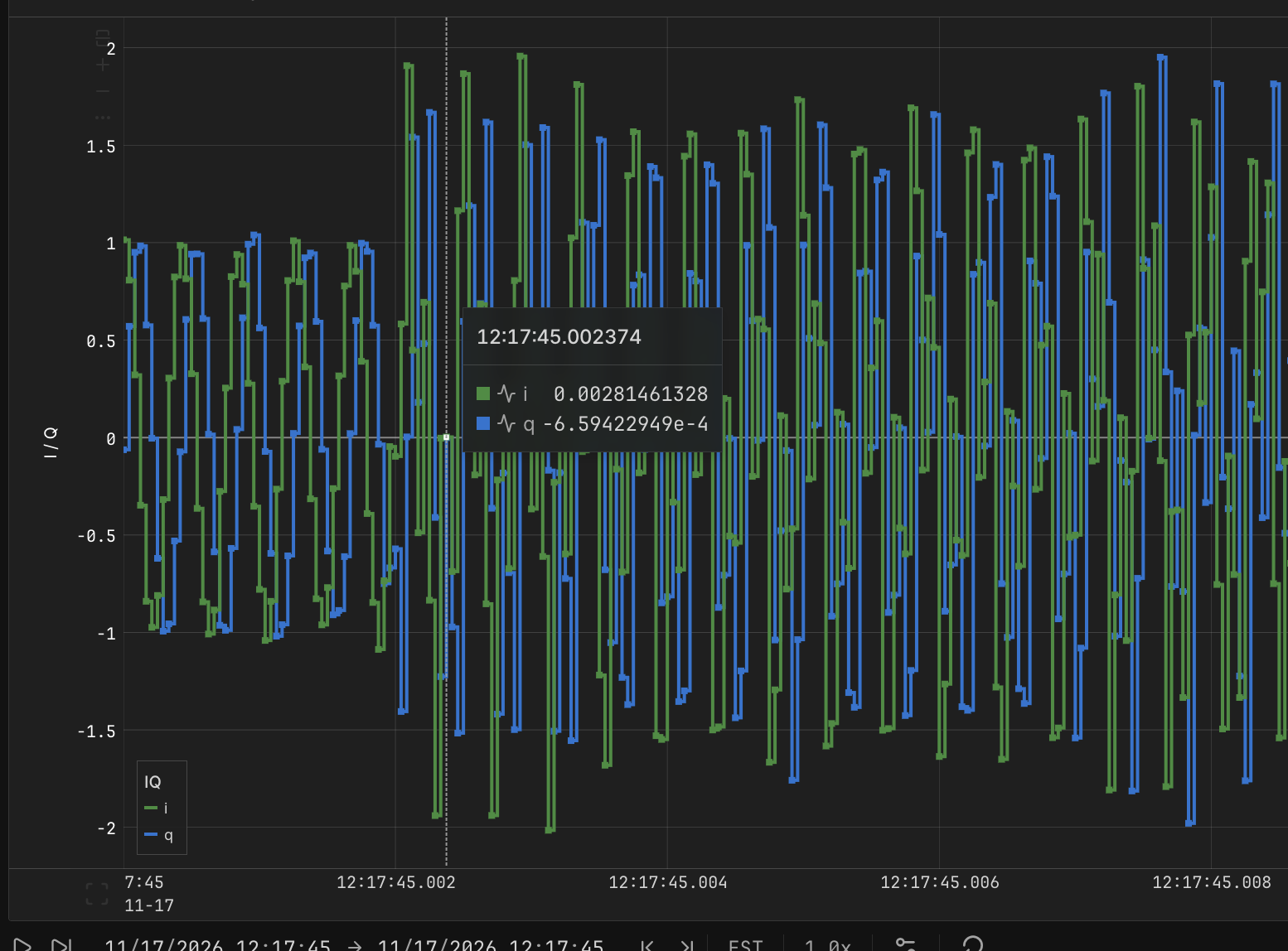
Stream a SigMF recording to Nominal in real time, as if a software-defined
radio were capturing it now, at the recorded sample rate or a fraction of it. The recording is IQEngine’s synthetic example by
Marc (CC BY 4.0): 2 seconds at 480 kS/s. It comes from
nbdemo.data, which downloads it on first use.
Requirements: a default profile
for the Nominal Python Client, and the packages the notebook imports, including nbdemo[rf].
Running the notebooks explains how to set them up.
Each execution of the notebook reuses the asset. It archives the dataset that earlier executions streamed to, so the asset holds one dataset: this execution’s.
Load the recording#
A SigMF recording is a metadata file (.sigmf-meta) and the raw samples (.sigmf-data).
nbdemo.data reads both; the metadata holds the sample rate.
import numpy as np
from nbdemo.data.rf import sigmf_synthetic

recording = sigmf_synthetic.native  # a SigMFRecording, downloaded on first use
rate = recording.sample_rate  # samples per second
iq = recording.read_samples()  # complex samples
print(f"{len(iq):,} samples at {rate:,.0f} S/s = {len(iq) / rate:.1f} s")
1,000,000 samples at 480,000 S/s = 2.1 s
Connect to Nominal#
from nominal.core import NominalClient, set_display_options

# A Nominal object at the end of a cell displays as a card.
set_display_options(time_format="readable")

client = NominalClient.from_profile("default")
Create the dataset#
asset = client.get_or_create_asset_by_properties(
    {"example": "sigmf_stream"},
    name="VirtualSDR",
    description="A virtual software-defined radio, replaying a SigMF recording",
)
dataset = asset.get_or_create_dataset(
    "iq",
    name="iq",
    description="The recording's samples, streamed in real time",
)
dataset
Dataset(rid='ri.catalog.cerulean-staging.dataset.20ab35ec-9ccf-9d67-fded-0754971736ca', name='iq', description="The recording's samples, streamed in real time", properties=mappingproxy({}), labels=(), bounds=None, is_archived=False)Stream#
A radio hands over samples a buffer at a time, so the loop sends 4,096 samples (8.5 ms) when that
buffer would have finished filling. Sample n is stamped with the start time plus n / stream_rate,
so the data has the same spacing as a radio sampling at that rate.
RATE_FACTOR scales the recording’s sample rate. At 1.0 the stream matches the recording’s
480 kS/s. At 0.01, the default, it plays at 4.8 kS/s: the same samples, a hundred times slower. The
docs build doesn’t run this cell, since it streams in real time.
Set LOOP_FOREVER = True to replay the recording until you interrupt the kernel, with timestamps
continuing across replays.
The status line below the cell updates every second. lag is how late the latest buffer was sent. It
stays near 0 ms while the loop keeps up with stream_rate, and the status changes to
FALLING BEHIND once it passes 100 ms.
import time

from IPython.display import display

LOOP_FOREVER = False  # True: replay until interrupted
BLOCK = 4096  # samples per buffer
RATE_FACTOR = 0.01  # 1.0: the recorded sample rate; 0.01: one hundredth of it
stream_rate = rate * RATE_FACTOR  # samples per second to stream
REPORT = 1.0  # seconds between status updates

start = time.time_ns()
sent = 0  # samples sent so far, across replays
worst_lag = 0.0  # the largest delay behind real time, in seconds
next_report = start
status = display("starting...", display_id=True)  # updated in place while streaming
with dataset.get_write_stream() as stream:
    while True:
        for i in range(0, len(iq), BLOCK):
            block = iq[i : i + BLOCK]
            index = sent + np.arange(len(block))
            times = start + np.round(index * 1e9 / stream_rate).astype("int64")
            sent += len(block)
            # wait until the buffer would have finished filling
            due = start + sent * 1e9 / stream_rate
            time.sleep(max(0.0, (due - time.time_ns()) / 1e9))
            stream.enqueue_batch("i", times, block.real)
            stream.enqueue_batch("q", times, block.imag)
            # lag: how late this buffer was sent, 0 when the loop keeps up
            lag = (time.time_ns() - due) / 1e9
            worst_lag = max(worst_lag, lag)
            if time.time_ns() >= next_report:
                next_report += int(REPORT * 1e9)
                elapsed = (time.time_ns() - start) / 1e9
                state = "OK" if lag < 0.1 else "FALLING BEHIND"
                status.update(
                    f"{state}: streamed {sent:,} samples in {elapsed:.0f} s "
                    f"({sent / elapsed:,.0f} S/s, streaming at {stream_rate:,.0f} S/s), "
                    f"lag {lag * 1e3:.1f} ms, worst {worst_lag * 1e3:.1f} ms"
                )
        if not LOOP_FOREVER:
            break
    elapsed = (time.time_ns() - start) / 1e9
status.update(
    f"done: streamed {sent:,} samples in {elapsed:.2f} s, worst lag {worst_lag * 1e3:.1f} ms"
)