


 instro
Arbitrary Waveform Generator (AWG)#
Using InstroAWG for SCPI-based arbitrary waveform generators
InstroAWG provides a unified interface for arbitrary waveform generators. This class is initialized with a vendor-specific driver (RigolDG1022Z, Keysight33521B, …), and provides the vendor-agnostic API (set_waveform, set_amplitude, set_offset, set_modulation, set_sweep, …).
Creating an InstroAWG#
from instro.awg.drivers import RigolDG1022Z
from instro.awg import InstroAWG

awg = InstroAWG(
    name="myAWG",
    driver=RigolDG1022Z(visa_resource="USB0::0x1AB1::0x0642::DG1ZA000000000::INSTR"),
    num_channels=2,
)
Supported Vendors#
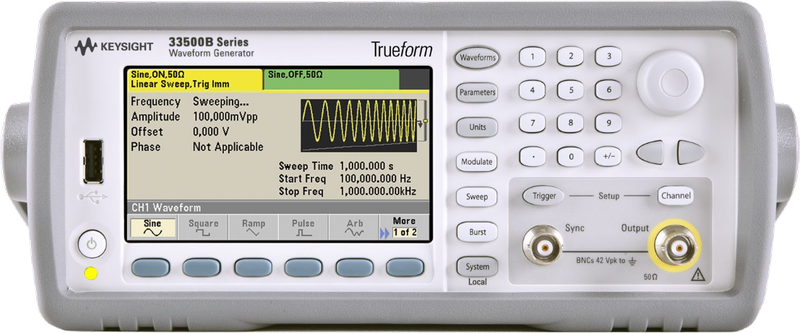
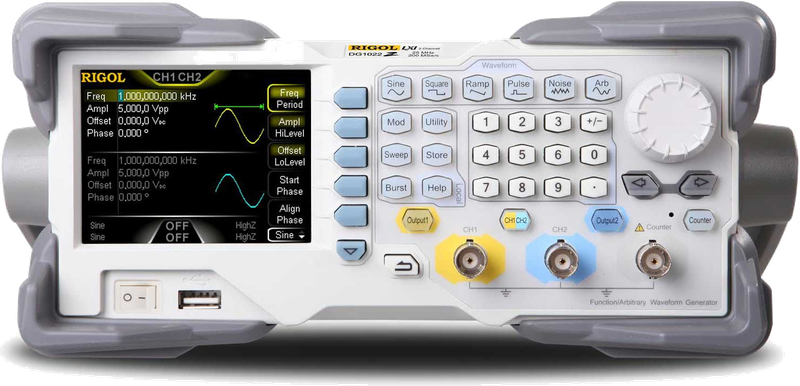
If your vendor or model is not listed, see Custom Driver Development, or open a Driver Request issue on GitHub.
Example#
More examples found in Examples
Details#
The following presents details about the InstroAWG. Specific driver details can be found on their pages.
Driver Composition#
An InstroAWG is built from a concrete driver:
InstroAWG("name", driver=RigolDG1022Z(visa_resource="USB0::..."), num_channels=2)
The
RigolDG1022Zowns the connection setup and vendor-specific command mapping.InstroAWGowns the category-level workflow: waveform programming, publishers, the background daemon.
Lifecycle#
The typical InstroAWG workflow:
Construct: instantiate the vendor driver and pass it to
InstroAWG, along with the channel count.open(): establishes the connection to the instrument.Configure and generate: define a waveform on a channel, set its amplitude and offset, and enable the output, etc.
start(): begins a periodic background daemon that polls output state. (Optional)stop(): ends the background daemon (if started).close(): disconnects from hardware.
Waveform Definitions#
InstroAWG supports programming a channel with the following waveforms: Sine, Square, Sawtooth, Triangle, Pulse, Arbitrary, or StaticValue. These are all frozen dataclasses in instro.awg.
Arbitrary requires a sample rate field (sample_rate_sas, in samples per second) to specify the number of samples that the internal DAC outputs per second.
Note
Driver support varies
Certain features are only available on particular waveforms. Drivers own their implementation of features in InstroAWG. Consult your specific driver for exact support.
RigolDG1022Z uses a bulk transfer for arbitrary waveforms over TCPIP when the complete command is smaller than 32 KiB. USB connections and larger TCPIP payloads use per-point transfers because bulk writes can hang the instrument firmware in those cases.
Init from a Config File#
InstroAWG can also be constructed directly from a JSON config file. See below for an example Rigol DG1022Z JSON configuration.
{
  "version": 1,
  "instrument": "InstroAWG",
  "device": {
    "name": "bench_awg",
    "description": "Bench waveform generator",
    "manufacturer": "Rigol",
    "model": "DG1022Z"
  },
  "driver": {
    "connection_type": "visa",
    "name": "RigolDG1022Z",
    "num_channels": 2,
    "visa": {
      "visa_resource": "USB0::0x1AB1::0x0642::DG1ZA000000000::INSTR"
    }
  },
  "channels": {
    "1": {
      "waveform": { "shape": "sine", "frequency_hz": 1000.0, "phase_deg": 0.0 },
      "amplitude": { "value": 2.0, "unit": "VPP" },
      "offset": 0.0
    }
  },
  "timing": {
    "poll_interval": 1.0
  },
  "publishers": [
    { "type": "NominalCorePublisher", "dataset_rid": "<dataset_rid>" }
  ]
}
from instro.awg import InstroAWG

awg = InstroAWG(config="bench_awg.json")
See Config Files for the full field reference.
Custom Driver Development#
For more information on writing a custom driver, see Custom Driver Development.