


 instro
Electronic Load (ELoad)#
Using InstroELoad for SCPI-based programmable electronic loads
InstroELoad provides a unified interface for programmable electronic loads. This class is initialized with a vendor-specific driver (BK85XXB, …), and provides the vendor-agnostic API (set_mode, set_level, get_voltage, …).
Creating an InstroELoad#
from instro.eload.drivers.bk_85xxb import BK85XXB
from instro.eload import InstroELoad

eload = InstroELoad(
    name="myELoad",
    driver=BK85XXB(visa_resource="USB0::0x0614::0x0960::8514B12345::INSTR"),
)
Supported Vendors#
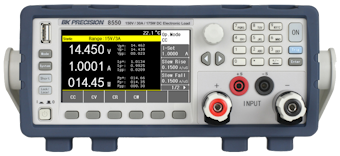
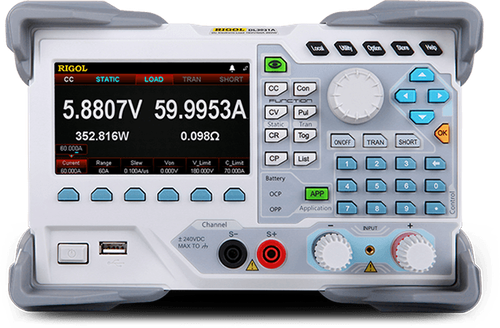
Virtual: no hardware or server; the load and its source simulated in-process (
VirtualELoad, see Virtual instruments)
If your vendor or model is not listed, see Custom Driver Development, or open a Driver Request issue on GitHub.
Example#
More examples found in Examples
Details#
The following presents details about the InstroELoad. Specific driver details can be found on their pages.
Driver Composition#
An InstroELoad is built from a concrete driver:
InstroELoad("name", driver=BK85XXB(visa_resource="USB0::..."))
BK85XXBowns the connection setup and vendor-specific command mapping.InstroELoadowns the category-level workflow: measurements, commands, publishers, the background daemon.
Lifecycle#
The typical InstroELoad workflow:
Construct: instantiate the vendor driver and pass it to
InstroELoad.open(): establishes the VISA connection.Configure and measure: set operating mode, level, range, and read measurements.
start(): begins a periodic background daemon. (Optional)stop(): ends the background daemon (if started).close(): disconnects from hardware.
Operating Modes#
Electronic loads can operate in four modes:
CC (Constant Current): the load draws a constant current regardless of voltage
CV (Constant Voltage): the load maintains a constant voltage across its terminals
CR (Constant Resistance): the load simulates a constant resistance
CP (Constant Power): the load draws constant power
Note
Mode Configuration Required
The operating mode must be set using set_mode() before you can configure the level or range. Not all electronic loads support all four modes. Consult your instrument’s manual.
set_range() support depends on the driver. BK85XXB supports CC and CV, and auto-ranges CP and CR from the level value. RigolDL30xx supports CC, CV, and CR. In other modes, set_range() raises NotImplementedError.
Init from a Config File#
InstroELoad can also be constructed directly from a JSON config file, which removes the need to write any Python setup code:
from instro.eload import InstroELoad

eload = InstroELoad(config="bench_eload.json")
Where bench_eload.json contains:
{
  "version": 1,
  "instrument": "InstroELoad",
  "device": {
    "name": "bench_eload",
    "description": "Bench electronic load",
    "manufacturer": "B&K Precision",
    "model": "8514B"
  },
  "driver": {
    "connection_type": "visa",
    "name": "BK85XXB",
    "visa": {
      "visa_resource": "ASRL3::INSTR",
      "serial_config": {
        "baud_rate": 9600,
        "data_bits": 8,
        "parity": "N",
        "stop_bits": 1
      }
    }
  },
  "load": {
    "mode": "CC",
    "level": 1.5,
    "range": 5.0,
    "slew_rate": {
      "direction": "BOTH",
      "rate": 0.5
    }
  },
  "timing": {
    "poll_interval": 1.0
  },
  "publishers": [
    {
      "type": "NominalCorePublisher",
      "dataset_rid": "<dataset_rid>"
    }
  ]
}
To try a config with no hardware, use the virtual driver: "driver": {"connection_type": "virtual", "name": "VirtualELoad"}. Optional source_voltage (V, default 12) and source_resistance (ohms, default 0.5) set the simulated source it draws from.
See Config Files for the full field reference.
Custom Driver Development#
For more information on writing a custom driver, see Custom Driver Development.