

Creating event metadata#
Mark a point or span in time as an event, such as a failure or an unknown state, so it can be found and reviewed. Events belong to one or more assets.
In code#
from datetime import datetime, timedelta, timezone
from nominal.core import EventType, NominalClient

client = NominalClient.from_profile("default")
asset = client.get_asset("<ri.scout.instance.asset.identifier>")
asset.create_event(
    "Overtemperature",
    EventType.ERROR,
    start=datetime(2026, 1, 1, 14, 12, tzinfo=timezone.utc),
    duration=timedelta(seconds=5),  # omit for a point in time
)
client = nominal.Client.fromProfile();
client.createEvent("<ri.scout.instance.asset.identifier>", "Overtemperature", Type="error", ...
    Timestamp=datetime("2026-01-01 14:12:00", TimeZone="UTC"), ...
    Duration=seconds(5));  % omit Duration for a point in time
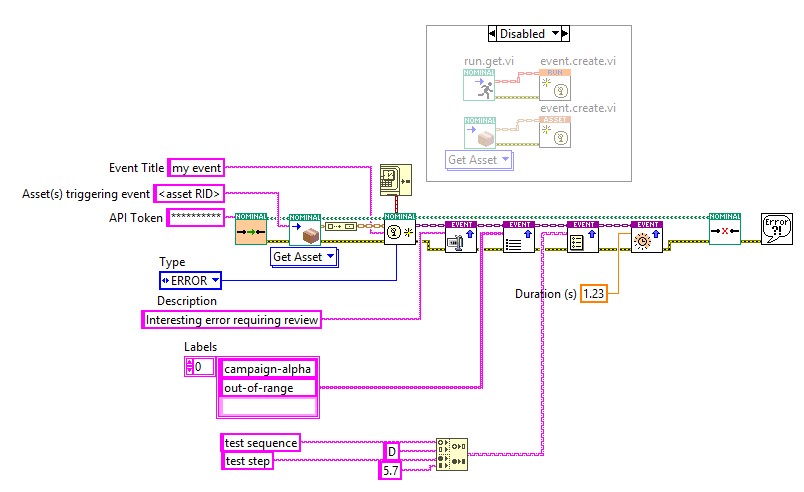
use std::sync::Arc;
use nominal::streaming::api::clients::event::{AsyncEventService, AsyncEventServiceClient};
use nominal::streaming::api::objects::{api::Timestamp, event::{CreateEvent, EventType}};
use nominal::streaming::api::objects::scout::{rids::api::AssetRid, run::api::Duration};
use nominal::streaming::client::{async_conjure_client, conjure::{http::client::{AsyncService, ConjureRuntime}, object::SafeLong}};
use nominal::streaming::prelude::{BearerToken, ResourceIdentifier};

let config = nominal::Config::load()?;
let profile = config.get_profile("default").ok_or("no profile named default")?;
let api = async_conjure_client("events", profile.base_url().parse()?).map_err(nominal::Error::from)?;
let events = AsyncEventServiceClient::new(api, &Arc::new(ConjureRuntime::default()));
events.create_event(&BearerToken::new(profile.token())?, &CreateEvent::builder()
    .timestamp(Timestamp::new(SafeLong::new(1_767_276_720)?, SafeLong::new(0)?)) // 2026-01-01T14:12:00Z
    .duration(Duration::new(SafeLong::new(5)?, SafeLong::new(0)?))               // zero for a point in time
    .name("Overtemperature")
    .type_(EventType::Error)
    .insert_asset_rids(AssetRid(ResourceIdentifier::new("<ri.scout.instance.asset.identifier>")?))
    .build(),
).await.map_err(nominal::Error::from)?;
import (
	nominalapi "github.com/nominal-io/nominal-api-go/io/nominal/api"
	"github.com/nominal-io/nominal-api-go/io/nominal/event"
	scoutrids "github.com/nominal-io/nominal-api-go/scout/rids/api"
	runapi "github.com/nominal-io/nominal-api-go/scout/run/api"
	"github.com/palantir/pkg/rid"
)

// httpClient is a conjure-go-runtime httpclient.Client for your Nominal REST API URL,
// and token is your API key as a bearertoken.Token
assetRid, _ := rid.ParseRID("<ri.scout.instance.asset.identifier>")
event.NewEventServiceClient(httpClient).CreateEvent(ctx, token, event.CreateEvent{
	Name:      "Overtemperature",
	Type:      event.New_EventType(event.EventType_ERROR),
	Timestamp: nominalapi.Timestamp{Seconds: 1767276720}, // 2026-01-01T14:12:00Z
	Duration:  runapi.Duration{Seconds: 5},               // zero for a point in time
	AssetRids: []scoutrids.AssetRid{scoutrids.AssetRid(assetRid)},
})
In the Nominal app#
In a workbook, drag across a time series chart over the span to mark, or click the chart at a point in time, and choose New event.
Enter a Name, such as
Overtemperature, and choose an Event level. Violation is the level that theERRORtype in code creates.Check the Timestamp, which your selection fills in, and click CREATE EVENT.